My title page contents

This is default featured post 1 title

This is a Sandeep Mishra. I am a SEO Expert in Lucknow..

This is default featured post 2 title

Go to Blogger edit html and find these sentences.Now replace these sentences with your own descriptions.This theme is Bloggerized by Lasantha Bandara - Premiumbloggertemplates.com.

This is default featured post 3 title

Go to Blogger edit html and find these sentences.Now replace these sentences with your own descriptions.This theme is Bloggerized by Lasantha Bandara - Premiumbloggertemplates.com.

This is default featured post 4 title

Go to Blogger edit html and find these sentences.Now replace these sentences with your own descriptions.This theme is Bloggerized by Lasantha Bandara - Premiumbloggertemplates.com.

This is default featured post 5 title

Go to Blogger edit html and find these sentences.Now replace these sentences with your own descriptions.This theme is Bloggerized by Lasantha Bandara - Premiumbloggertemplates.com.

Monday, 3 February 2014

Google Updates- Latest SEO News Techniques


Get Latest Seo news Techniques, search engine optimizations updates in Google, penguin updates, matt cutts google algorithm, latest panda update, what is white hat seo, black hat seo tactics, how to do Social Media Marketing, learn link building tips, on page seo, what is SEO, off page Seo tricks.

Matt Cutts, Google’s head of search spam, made an announcement on Twitter that action has been taken on another link network:

In a tag on up to that tweet, Matt added in the form of a reply: “today France; Germany soon.” So expect news in the near future of a German link network being taken down.
That marks two more link networks to fall victim in Google’s ongoing crusade against websites that openly violate Google’s guidelines.

Buzzea is one of the few to really take offence to being called a link network and attempt to protect themselves. In a translated statement posted on their website they state that they “oppose this declaration since we never stopped wanting to keep the ethical side of sponsored articles focusing on quality and natural links created.”

However, in the same statement they also decided it was time to leave their business behind: “This marks the end of an adventure for our team but also the end of our collaboration with thousands of publisher sites, agencies and advertisers who have given us their trust.”


That trust Buzzea speaks of will likely result in a warning in Google Webmaster Tools very shortly, as well as a dip in rankings. It would be wise of anyone who participated in the link network to disavow the links immediately and stay far away from anything resembling a link network in the future. 

Thursday, 30 January 2014

Google EMD Update: Exact Match Domains

What is Google’s EMD Algorithmic Update?


Google is going after "low quality" exact match domains (EMD) to ensure they do not rank well in the Google search results. 

It seems like many sites were hit, as many webmasters have reported being hurt by this update. A WebmasterWorld thread has several webmasters claiming to be victims. I will do a poll on this in about a week, I don't want to poll our readers until they have time to investigate if they were impacted by this. But it seems pretty significant, especially for SEOs and domainers.

It’s still early, but it seems that it’s not intended to wipe the search results entirely clean of sites with spammy domain names. Rather, it’s intended to keep the search results in check for anything that could ruin the user experience.

Furthermore, Danny Sullivan of SearchEngineLand wrote that Google confirmed that the EMD algorithm is going to be run periodically, so that those that have been hit stay filtered or have a chance to escape the filter, as well as catch what Google what might have missed during the last update.
It’s clear that Google wants its search results to be natural and free of manipulation. What used to be one of the industry’s most powerful ranking tactics is now something that could 


Thursday, 16 January 2014

Changes in SEO: What You Need to Know in 2014


In the spirit of a New Year's Eve edition, I'm presenting some of the most popular (according to the US Government) New Years Resolutions through an SEO lens, in the hope of spreading some good cheer and great strategy along with a very happy new year to you and yours!

The 2013 Updates
So what exactly changed in 2013? Most of what occurred came as a result of Google algorithm updates.

Panda was first introduced in 2011 to reduce the amount of content farming that was going on within websites. In 2013, Google updated Panda on multiple occasions, although this was not anything that webmasters weren’t already used to.

Penguin 2.0 (May 2013) and 2.1 (October 2013) brought more to the algorithm to fight against spam links and dish out more penalties for sites that broke the rules.


However the biggest and most significant update Google has tackled in years wasn’t an update at all — it was a massive algorithm overhaul in August 2013

Hummingbird completely changed the way sites would look at their content, keywords, and SEO strategies. It gave a heavier focus on semantic search and placed greater emphasis on the power of the Google Knowledge Graph.

Preparations For 2014
The rules, guidelines, and even major players in SEO seem to shift and adjust on a regular basis. While it is impossible to predict exactly what will happen next, it is possible to make assumptions and form strategies from there.

To have effective SEO in 2014, make sure your site is optimized for mobile users, provides quality and informative content, and has a high level of authority.


Continue to stay up to date and follow guidelines that Google lays out as you work to improve your site’s traffic and rankings.

Wednesday, 8 January 2014

Google Webmaster Tools Now Shows Exact Number of Clicks per Keyword by URL

You know the search queries report in Google Webmaster Tools? Of course you do. Do you know, you can show your top pages by impressions and clicks? Did you know that now you can see the top keywords that led to impressions and clicks to those pages?

Friday, 3 January 2014

Google Not Indexing Your Sitemap URLs? Might Be A Canonical Issue

                                           
A Google Webmaster Help thread has a webmaster all upset that Google shows that they have indexed none of the URLs they submitted via the XML Sitemap file. Obviously, this can be concerning to any webmaster.

The thing is, you need to be careful what Sitemap file you submit. If you verify a non-www version with Google Webmaster Tools and submit a www version of your sitemap, or visa versa, Google may be very literal and show you that they didn't index any non-www versions of your URL.

Google's Zineb said in the thread:

    All the URLs listed in your XML Sitemap are non www. and they all permanently redirect to the www. version (which is your preferred domain). That explains why these specific URLs are not indexed. In order to fix that, you'll need to specify the right URLs with www., resubmit your Sitemap and wait for it to be processed again.

So technically, it is an "easy fix" and the site is indeed being indexed. But a report like this can be scary to see in Google Webmaster Tools.


SEO 2014 Updation: Google Can not Crawl You Site


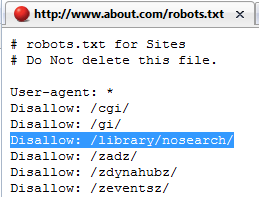
If Bot Can Not Crawl Your Robts.txt file Then we stop Crawling Your Site

Did you know that if Google cannot crawl your robots.txt file, that it will stop crawling your whole site?

This doesn't mean you need to have a robots.txt file, you can simply not have one. But if you do have one and Google knows you do and it cannot access it, then Google will stop crawling your site.

Google's Eric Kuan said this in a Google Webmaster Help thread. He wrote:

If Google is having trouble crawling your robots.txt file, it will stop crawling the rest of your site to prevent it from crawling pages that have been blocked by the robots.txt file. If this isn't happening frequently, then it's probably a one off issue you won't need to worry about. If it's happening frequently or if you're worried, you should consider contacting your hosting or service provider to see if they encountered any issues on the date that you saw the crawl error.


Thursday, 5 December 2013

6 Main Google Changes Demonstration the Future of SEO (Search Engine Optimization)


The last few weeks have been amazing. Google has made some big changes and they are all part of a longer term strategy that has many components.
You could argue that "tactical SEO is dead", but that's not quite right. And don't run around saying "SEO is dead" because that is far from the truth, and I might just scream at you.

The Main Changes are:

1. '(Not Provided)'

Losing Google keyword data is sad for a number of reasons. This impacts publishers in many ways, including losing a valuable tool for understanding what the intent of customers that come to their site, for conversion optimization, and much more.

For tactical SEO efforts, it just means that keywords data is harder to come by. There are ways to work around this, for now, but it just won't be quite as simple as it used to be.

2. No PageRank Update Since February

Historically, Google has updated the PageRank numbers shown in the Google Toolbar every 3 months ago or so, but those numbers haven't been updated since February. This means 8 months have gone by, or two updates have been skipped.
In addition, Google's Distinguished Engineer Matt Cutts has said Toolbar PageRank won't be updated again this year, leading many to speculate that PageRank is going away. I won't miss it because I don't look at PageRank often and I normally don't have a Google toolbar in my browser.
However, a lot of people still use it as a crude measurement of a site's prominence.

For sites with a home page that has PageRank 7 or higher, it may in fact be reasonable to assume that the site has some chops. Correspondingly, sites with a home page that has a PageRank of 3 or lower, it is either new, or probably a low quality experience. Stuff in the middle, you just don't know.

3. Hummingbird
If the idea that SEO is dead crosses your mind or turns up in print, dismiss it. The fact is that nothing is really going to change in the way that we pursue the almighty ranking, with the possible exception of the resurgence of the long tail keyword, which was working its way back into our hearts anyway. Everything that worked before Hummingbird’s release will still work moving forward.

4. Google+

OK, this one isn't new. Google launched Google+ June 28, 2011.
While it seemed to get off to a slow start initially, many argue that it has developed a lot of momentum, and is growing rapidly. The data on Google+'s market share is pretty hard to parse, but there are some clear impacts on search, such as the display of personalized results:

5. Authorship

OK, authorship also isn't new (launched on June 7, 2011), but it is a part of a bigger picture. Google can use this to associate new pieces of content with the person who wrote it.

Over time, this data can be potentially used to measure which authors write stuff that draw a very strong response (links, social shares, +1s, comments) and give them a higher "Author Rank" (note that Google doesn't use this term, but those of us in the industry do).
We won't delve into the specifics of how Author Rank might work now, but you can read "Want to Rank in Google? Build Your Author Rank Now" for my thoughts on ways they could look at that.

That said, in the future you can imagine that Google could use this as a ranking signal for queries where more comprehensive articles are likely to be a good response. Bottom line: your personal authority matters.

6. In-Depth Articles

Often when you're searching on Google for a person or organization name, or other broad topic, you'll find a block of search results labeled "In-depth articles." These results provide high-quality content to help you learn about or explore a subject. While the feature is based on algorithmic signals, there are steps you can take as a webmaster to help Google find your high-quality, in-depth content and best present it to users in the search results page.


ssss